

 Apple Podcasts

 YouTube

 Spotify

 Amazon Music

 iHeartRadio

 TuneIn

 Goodpods

 Podchaser
 RSS Feed
From Mob Lawyer to Mindfulness Mentor
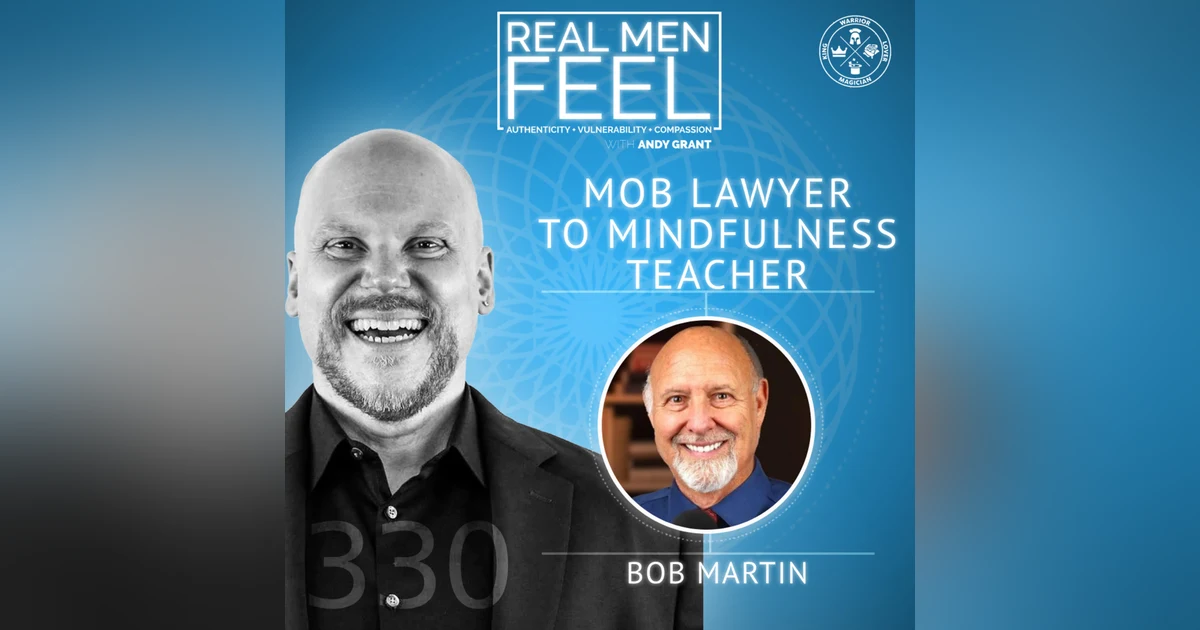

Legal Thrills and Spiritual Wisdom with Bob Martin In this episode of Real Men Feel, host Andy Grant welcomes Bob Martin, a former mob lawyer during Miami's cocaine cowboy era who transformed into a healing and mindfulness coordinator, meditation mentor, and author. Bob shares his journey from high-powered legal battles to teaching wellness and mindfulness, blending Taoist teachings with brain science and psychology.
They discuss meditation, mindfulness, the role of defense attorneys in the justice system, and the significance of yin and yang energy. Bob also reveals key moments that led him to change his life path and offers advice for those seeking to begin their own mindfulness practice.
00:00 Introduction to Real Men Feel
00:11 Meet Bob Martin: From Mob Lawyer to Mindfulness Mentor
01:09 Bob's Early Career and Transition
04:09 The Role of Defense Attorneys
08:42 Discovering Taoism and Master Ni
11:55 The Practice of I Ching
20:06 The Work Ethic of Happiness
25:46 Bob's Journey to North Carolina
27:35 Mindfulness and Meditation
33:37 Bob's Personal Challenges and Triumphs
37:21 Conclusion and Final Thoughts
Links
What Is Meditation Anyway, And Is It For Me? free ebook by Bob Martin -- https://www.awiseandhappylife.com/what-is-meditation-anyway/
Connect with Bob
Bob Martin -- https://www.awiseandhappylife.com
LinkedIn -- https://www.linkedin.com/in/bob-martin-995b30127/
Facebook -- https://www.facebook.com/awiseandhappylife/
Resources
Balance -- https://balanceapp.com
Insight Timer -- https://insighttimer.com
Connect with Andy and the Real Men Feel Podcast:
Interested in a Clarity Call with Andy? - visit https://theandygrant.com/talk
Instagram | @realmenfeelshow & @theandygrant
Personal Website | https://theandygrant.com for coaching, healing, and book info!
Podcast Website | http://realmenfeel.org for all things podcast-related!
RMF Facebook Group | http://realmenfeel.org/group
Support this podcast | https://anchor.fm/realmenfeel/support
YouTube | https://youtube.com/realmenfeel
#RealMenFeel ep 330
0:00 Hello and welcome to Real Men Field. I'm your host, author, coach and healer, Andy Grant. You could visit theandygrant.com to learn more about me. Real Men Field reminds me that they're human beings and they have the right to experience and express all of their emotions. My guest today is Bob Martin. Bob's journey takes him from a high-powered mob lawyer during Miami's Cocaine Cowboy era in the 70s and 80s to being a healing and mindfulness coordinator, meditation mentor, and author. Currently serving as a professor of Wellness and mindfulness at Elon University, Bob blends Taoist teachings, brain science, and psychology to help individuals break free from limiting beliefs. Bob has LED quite an interesting life, and you'll hear who he sees as the people who enforce the Constitution. AOI began as a mob lawyer and what happened when he first received the message to retreat?
0:46 Bob's journey is full of highs and lows, and his lessons combine Taoism and Buddhism. We discussed meditation, mindfulness, relaxation, and much more. He shares what he's proud of, what he wishes more men knew, and how to get his free ebook. What is Meditation and is it for Me? Let's do it. Hello Bob, and welcome to Real Men Feel. Thanks, pleasure to be here. Yeah, when I when I first discovered, I think it was on Podmatch, I found you. That's a kind of matchmaking service for podcasts, for people that aren't familiar. You describe your journey as going from an arrogant mob lawyer during Miami's Cocaine Cowboy era to a healing mindfulness coordinator and meditation mentor and published author. So the cowboy cocaine era, That's the 80s. 70s, yeah, 70s and 80s. 70s and 80s OK, so. It was the time of Miami Vice, Yeah, and Scarface and. So is it was that was that glitter image, Is that like what drew you into being a mob lawyer to begin with? Well, it it was good question.
1:48 It wasn't so much of A choice. It's just the evolution of the situation. When I graduated law school, Janet Reno, who was running the Miami DA's office at the time, swooped me up and I started working there and I rose to be in the economic crimes and consumer frauds division. And the mob was kind of hard to prosecute, but we went after their money with something called Rico, or Racketeering Influence Corrupt Organization Act. We hit him for many, many 72 million. And I was a part of that task force. So shortly after that, I left the DA's office, went out into private practice and I'll call him.
2:35 Johnny came to visit me and basically said that he had some pretty good lawyers and I was able to beat him and he wanted to send me some clients because he thought I was a good lawyer. So that's how I got involved with them. OK, so you let's see, So you weren't truly, well, I don't know, I mean, everyone's entitled to a defense. So you're you because you went from a prosecutor to an offense attorney and you and your specialty were were acting mobsters. Well, I, it wasn't like I was conciliary, OK? I wasn't on the inside. First of all, I'm not Sicilian, so we can't. However, they needed somebody to refer their folks to the mules that got arrested and the mid level people who, you know, would be charged with trafficking charges and the like. And they paid well and they paid in cash. And so I, I, I came to know them and hang out with them and, and get to know them on a personal as well as a professional level. And I've got some stories around that. But I it wasn't like I was on the inside of it, OK? So that's what got you in you're you're so good that the other side wanted you to work for them. Yeah, yeah.
4:03 So what happened in your life to say enough of that and make a transition? Can I, can I just go back for a loan about something you said about representing those kinds of folks? OK, So a lot of people ask me that question, and I always love to take the opportunity to answer it. There's a number of reasons why defense attorneys can do what they do, because one of them is that when you go into court, the other side's not going to take it easy on you and they're going to whack you over the head. And finally, you get up and you want to fight back just on a personal level, you know, but the other thing that's really important about defense attorneys is that the the prosecutors and, and the police officers, they enforce the law, but defense attorneys enforce the Constitution.
4:57 We're the ones that keep the private citizen away from the government or protect them from government overreach and excess. And basically it's like if you're going to take my guy, OK, you can take him. But you're going to dot your IS and cross your T's and you're going to do it by the book. And I'm going to make sure that I hold you accountable to it. And that keeps the system honest. And so we take our role, you know, as guardians of liberty real seriously. So I don't always do it for the dirtbag, but I do it for the system in order to keep it moving in the right direction. Right.
5:39 Again, because even a dirtbag has to be proven guilty of something. You can't just go assume it, right? Got it. Yeah. And if you if you give the prosecutor an inch, they'll start taking it and they'll cut corners and then innocent people start to get convicted. And that's nobody enjoys all right. But anyway, no. Great. No, I'm I'm glad you took the time to to clarify that. And and I love that, that that line of defense attorneys are the people that enforce the Constitution. I've never heard that that spin or I've never heard anyone, well, except one former and future president kind of claim to be I protect the Constitution, but we'll see what happens there. All right.
6:22 So so again, what led to the transition of of leaving that that life? Yeah, so I was, you know, riding high and I, I had a good reputation. I was well respected. I was making a lot of money, paid my house off by the time I was 32 and was investing in businesses and stuff and going out with these guys and partying a little too much and thinking too much of myself. And, you know, those who they didn't call them the cocaine Cowboys for nothing. And there was a lot of powder around. And when you do that stuff, you feel real arrogant and you feel real invulnerable.
7:04 Nothing can hurt you. And that's not a great way to keep a safe and happy life. And so things were kind of going down the doghouse personally, and I was seeing a therapist and one day I came to a real important crossroads. I was feeding money into a business that I thought was going to make me a billion dollars and it was just sucking me dry. And I I said, George, George, what should I do? So George started throwing coins and making mathematical calculations and came up with the number and picked up a book and opened it to that chapter number and showed it to me. And the title of the chapter was retreat. And, you know, I'm paying the guy a good much money to be my therapist, not to be a soothsayer, right? And it kind of freaked me out, and I kind of got mad at him. I stomped out.
8:05 But I couldn't help but have that word retreat, you know, retreat. And so I made a decision that I would pull back. You know, I take a look at myself and look at what I was doing. So I started to wean myself off of some of the excesses and come to find out when I went back to see George with my tail between my legs and asking him like, what was that? And and he said that was the AI ching and I said, what's that? And he said, well, it's a Taoist practice. And I said, what's Taoism? So turns out that my therapist was the English language editor, disciple and devotee of a 70 second generation Shaolin priest.
8:53 Think about that 72 generations. It's about 1400 years of the handing down the learning from father to son to father to son. And so Master Knee came to Miami frequently, and he got a little Dallas group going, and George let it when he wasn't there. And when Master Knee came, we sat at his feet and listened to his wisdom. And he was just the most amazing human being, somebody who had actually gained mastery in life. He's unflippable, unflappable, always had the exact right thing to say, was always appropriate, always kind, and you just love being near him. We asked him once, you know, what's it like to be Master Knee?
9:48 And he says no rehearsing thoughts, No rehearsing thoughts. He, he, he didn't ever think about what he was going to do next or what he was going to say. It just came out automatically for him, like muscle memory. And he explained to us that that was a state in Taoism that's called Wu Wei, or doing, not doing where you don't do anything. But nothing remains undone. And I think that we Westerners understand when an athlete is in the zone and they're just making every 3 point shot and they can't make a mistake.
10:31 They're doing everything perfect and they come in, they say, wow, it was a great game. You know, how'd you do that? And they'll say something like, wow, it didn't even seem like it was me out there. But we call that being in the zone. And Master Nee taught us that you can live your whole life like that. So. Oh good. So I wanted to ask you, you say Master Nee had gained mastery in life. Can can anyone gain mastery in life? Well, to get to to get to where he was, you'd have to spend an awful lot of time practicing, you know, I mean, he, he, he lived in a temple and was handed started practicing at a very, very young age, being taught by his father. So, yeah, anybody can do it.
11:18 I mean, but we can, it's hard to achieve that level without being monastic, you know, without going to a monastery. But we can achieve enough of it so that life can become more effortless and efficient, yet efficient and effective but more effortless. Right. So not a completely effortless state, but more effortless than you were the day before. Right. And more resilience, you know, it's not. You won't get knocked down, but you get up a lot faster. Right. So during the sounds like it was years of studying with Master Knee.
12:01 So there, there must have been things, it had to be more than lectures. They must have been practices you, you took in and and discovered that the fruits of those were really beneficial for you. So what? What was that like? Well, you know, you, you've heard of Qigong, Tai chi, Kung Fu. Those are all Daoist practices, physical practices, but there are a lot of contemplative practices. And one of those practices is practicing the AI Ching, which is what my therapist had done when he threw the coins. And it's I, I practice the Jing all of the time that I was with me and I still practice it even now, 20 years later. Not every day as I used to because I don't have to. I've ingrained a lot of, it's ingrained already in me. But whenever life, you know, presents me with the situation where I'm confounded, you know, I, I just, I pull out the old book and throw the coins and invariably, you know, it gives me a direction to go in.
13:08 So I'm familiar with the AI Ching as a book and that's all. So anyway, there's, there's an element of, of throwing coins to, to, you know, have have guidance to what to read. That's the point. Yeah, that the book that most people are familiar with is the Tao to Ching. Yes, that's it. And the Ching Tao to Ching, the Ching means the classical book, Tao means the way and Tai means virtue. So it's the classical book of the way of virtue. But the E Ching is the classical book of changes and it is it is definitely a practice, not something that you read from cover to cover. And if I, if I can tell you what Carl Jung said about it, he he was fascinated with the I Ching and wrote several great treatises. And basically what what Carl Jung said is that you have two intelligences. 1 is verbal and rational and the other is intuitive and nonverbal.
14:11 Whenever we feel we have a hunch, we have an idea. We don't. Things don't feel right. Well, we're noticing things and our intuitive mind is sending us up a little warning signal. So what, Carl, you discovered was that if you asked it a question that was open-ended, no, yes or no questions, just what do I need to know about today's interview, That kind of thing. And then you occupy the rational mind with math, which is the rational mind loves math. And so you do the coins and you're adding up tails and heads and making lines and figuring out these different lines. And that leads you to a code which you decipher. And then that leads you to a chapter and a couple of special lines and another chapter in the I Ching. So you go and you read that, but here's where the I'm going to say in air quotes, here's where the magic happens. Your intuitive mind has been working on the question all the while that you've been doing the math. And so when you read the reading that you've been directed to, your intuitive mind will highlight the words that are in that reading so that it can bridge what it wants to tell your rational mind.
15:41 It acts as a decoder and it allows your intuitive mind to become verbal so that now you can effectuate the answer which you really already knew. Does that make that? Did I say it right? I don't know if you said it right, but it made sense to me. I can, I can. I can at least pretend to follow that. I'll do that. That's cool. Let me give you an example, all right, Let's say, let's say that you are in a situation where you've got this brilliant idea and you're excited about it and you want to go share it with some friends. And you go and they're just, they're into something else at the moment and they're not listening. And you might ask the E Jing, what do I need to know about this situation?
16:36 And what your intuitive mind will probably be telling you is that they're busy with something else. And this isn't a great time to try to force your ideas on them. And you just sit back and be patient and wait until they're ready to listen to you. And then in the meantime, you know, prepare what you want to tell them so it's as clean as possible. And when they're ready to listen to you, then you'll have an opportunity to give them your idea. So you probably we, you and I would know that instinctively, but we may not have it up in our consciousness, right? But by throwing the E Jing we would get that out of it. Right. So it's it's a just a, an external tool to our inner wisdom to get the interest that we already know on some level.
17:21 That was a much more succinct, concise way of saying it. Good job. Thank you, I I really appreciate that because I have not heard the practice of that explained so, so clearly and well. So I that, that was great. It sounds like how people use AI today, right? Just asking questions, opening ChatGPT. Oh, what should I do today or how should I prepare for the interview? How you know, what should I talk to my friends with my idea? A lot of people using AI for that. Do you think that's giving as can? Can AI be intuitive? Well, here's the thing, if we if we're thinking that AI or the I Ching is actually going to give us the answer, then we're correct with AI, 'cause you're going to ask it a question and it will go through its database and give you an answer based on its database. But if you're looking to access your inner wisdom and make conscious the answer which you already know to be true, I don't think that AI can do that for you. Because you need the time of of distracting your rational mind and get it out of the way so that your intuitive mind can be free to work on the issue.
18:45 I'd that piece of the practice is an important piece. So AI is just a rational mind. AI would be, Yeah, you would. It's, well, it's call it the verbal mind. AI is totally verbal. Cool. Yeah, so I, I do Akashic record readings and it's similar, just another, another way to access and your wisdom and any way to get there. And I haven't done this yet, but I thought it'd be cool to like, I'm going to ask ChatGPT questions about myself after I asked them in the Akashic records and then see how different or very they are, just as an experiment to see, you know, does AI have any? Because it's hard to imagine that AI could have a sense of spirituality or connection. But you know, I don't know.
19:27 You know, AI is pretty amazing. I sometimes wonder about it because I find that whenever I'm polite with it and I say please and I ask it if you would or could you, it always seems to be more accurate for me. Maybe it could be, you know, just my read on it, or that's what I want to believe, but I don't know. It just seems like it has a sense of that. And I've asked it a lot of spiritual questions and gotten some pretty good stuff. Write some wonderful poetry. One thing I noticed in in your bio was a topic you like is the work ethic of happiness.
20:13 Can you expand on that? A lot of people think that happiness is something that happens to you, you know, but it's really something that you generate from inside. If you depend on the world to, you know, keep you happy, then you're going to find that you're going to be living on a roller coaster pretty much. There is this certain, there's certain work that's necessary internally in order to be able to generate that happiness on a regular basis. Awe is another thing like that. The, the sensation of awe. Most people say, well, you know, you have to actually be in a sunset that's gorgeous or you have to be, you know, gazing upon this or that. But awe is something which if you, if you put the time in, there are ways to cultivate a sense of awe so that you can access it more.
21:15 And the same thing is true of happiness, Understanding a little bit about how the brain works, doing some, doing a little bit of. So there's some knowledge that's involved about how you actually work internally. And then there's, you know, the practice of contemplating what really works for you and what doesn't. But I think the most important thing about happiness is to break free from identifying with your thoughts that you are your thoughts when when you're trapped inside of your thoughts.
21:56 If I see something and I have a judgement and that judgement becomes not only my truth, but the truth, I am not free to access that, to make little adjustments that bring me back into balance. So when I can step back and notice that my thoughts are something that I generate because we said, what do we say? We say I had a thought, right? So who is the I that had the thought? And when we can start to pull back from that thought. And so all of that takes a bit of intentionality. And if, if I know I'm going on here, but if I can go into one other little aspect of that, would it be OK?
22:40 So if you look at evolutionarily, we it took 2,000,000 years or so for us to evolve from CRO magnon to Homo sapiens. And during that period of time, we were hunter gatherers. We lived in a very, very clear and simple environment where what we saw we could trust as being real. And if danger was presented to us, we knew why. But today, and, you know, we did a lot of physical labor and we didn't eat all that much. You know, we ate field onions, berries, roots, and every once in a while we were able to kill a wild boar or something.
23:25 But not a lot of salt, not a lot of sugar, not a lot of fat. Today we get more that in a McDonald's Happy Meal than we ever got in the jungle in a month. So our physical bodies are not adapted to the lifestyle that we're living now. And the same is true of our minds. And if we don't take some intentionality to build up our sense of joy and to intentionally increase our experience of joy and happiness, we won't build up the neural pathways that will balance out the stress that the world gives us.
24:07 So we have to be aware of this and we have to intentionally surround ourselves with things that bring us joy. You've mentioned awareness a number of times and I agreed to to start recognizing yourself and where your thoughts come from and then and getting that separation work requires some witnessing of being able to step back and see it all. And I know for me, my path to developing any awareness began with with meditation, with a meditation practice. So what was meditation part of the initial trainings for Master Knee for you? Not so much. Taoism is more contemplative and is more for boreal.
24:49 I would say. By doing the Tai Chi, you begin to feel the ebb and flow of energy and then you start to apply that to the ebb and flow of things in your life. You contemplate a lot of stuff. You read the data Jing and you sit back and you stay with it. It's not so much a formal meditation practice as Buddhism is. When I came to North Carolina, there's not a lot of Dallas here in North Carolina. So I started going to Buddhist temples and that's when I got involved in meditation. And then I was called to a two year certification or training to become a teacher. But yeah, it was it was meditation, ultimately that gave me the life I have today.
25:39 So. So today you practice elements of both religion and spiritual practices. OK, right. And was it a quest for more peace and serenity that got you to North Carolina or what? What did that for you? Well, I had an agreement with my mob clients that I wouldn't do anything unethical or illegal and that worked up until his son got arrested and charged with a 15 year felony and then there was no saying no. And at that point, after studying with Master Knee, there was no agreeing with him. So he came to a place where not only would I not do what he demanded of me, but if another lawyer did it, I would be obligated to report that lawyer.
26:30 So I didn't have much of A choice but to leave Miami. And I was passing through North Carolina. The azaleas were blooming and, and, and the Dogwood trees were out. And I just thought I'll move here and went back and told Johnny and he said, OK, well, sometimes a man has to move on. We shook hands and never heard from them again. Wow. That's an amazingly peaceful ending to what could might not have been so. Might not have been. Yes. Awesome. So then that would that move was the end of your legal career. No, I, I, I came to a smaller town and I went back and started over as ADA in this town and worked there for 5-7 years and then went out in private practice.
27:19 And I speak Spanish and at that time I was the only Spanish speaking lawyer in town. So I got a lot of the migrants would come to me for their driving while impaired or accidents and stuff like that. So a lot of mindfulness is often a buzzword. It really rises up now and then it, it, it feels like it's at another peak. Do you have any advice for people that are, you know, hearing that term mind, like, how do I start my mindfulness practice? Like what would you? What would you point them to? Well, the first thing I would tell them is a lot of people ask me that question. So I wrote a 40 page e-book that's Ioffer that is free and it's called is Meditation for me.
28:04 What it is, what it's not, how to do it and how to get started. And I have a lot of resources in there and a lot of explanations of meditation. So it's free or you know, it's free to download and there's really no obligation. So I would say, you know, get that book and look through it. It's got a lot of resources in it. But, you know, besides that, there are many apps and there are many books. To tell you the truth, there's only a couple of apps that I really favor a lot of A lot of apps that claim to be meditation apps are really relaxation apps.
28:46 And meditation is not necessarily relaxation. Yeah, it if you meditate, you will become more relaxed, but that's not why you meditate. It's a side benefit that just happens. If you're looking to meditate in order to become peaceful and tinkly and hug trees and all that, then meditation is not that. Relaxation is there. And relaxation is very important because your brain broadens and builds. All kinds of great things happen, but it's it's just not meditation. I think the best apps for meditation is one called Balance, which actually has an AI, has an AI coach and then Insight Timer has many, many, many, many aspects that are just wonderful for a beginning person. And of course, Ioffer classes in meditation and the way that I teach is fairly unique.
29:58 No, Well, it is unique because I I use a proprietary app where the guided meditations are on the app. And then after you listen to it and spend a few minutes you following the instructions of the meditation, then you're asked to log while you respond to that. And every single day in my five week course, those logs come to my dashboard. And every single day I get up in the morning, I read the log and I give coaching.
30:38 So every single day it's like you're, you know, it's like we're like you're my roommate. And every day you're getting you're getting more advanced. And so it's it's highly effective. I teach it to college students on campus. And I got to tell you after the third week when they really start getting it, I mean, it's like my heart blows up. You know, I mean, I see these kids who started out and, and, and an entire new world it opens up for them. And you know, I get these comments like I feel as free as I ever have. Or I couldn't do my homework and then I did my 10 minutes and then I could, or I just noticed there are crickets outside my windows. And it's just I, I really do.
31:30 I get my life from it. Awesome. Yeah. And those, those little moments are they're moments of awareness and they come from, I mean, often people meditate to to get that awareness. So, so great. So we'll have links all over real men feel the blog post for this episode, for the for the apps you mentioned all the books and everything. But does anything stand out as kind of the most surprising to you transformation of any meditation student you've had? Yeah, I mean, there's, there's several, but I think one that really stands out is one student came to me after the second class and confided in me that he was a picker, you know, which is a nervous habit. And by the end of by 4 weeks later, he'd stop picking. That was just something that is very real, very physical, very, you know, definable.
32:28 But, you know, one of the things you ask about what surprises me is, and since this is a, you know, real Men Feel podcast, sometimes I'm just surprised at how underrepresented men are in seeking out meditation as a tool and that that pains me. You you must have seen an increase over the years though. If I have a class of 12, I'll have two guys in it. I also coordinate all the mindful activities on campus for the faculty and staff, and we have a lot of lunch and learns. I'll have 17/18/20 people show up, two or three guys.
33:12 All right, so I'm used to being one of those two or three guys. And so, and that was, you know, my journey. I think it's been at least 15 years on my real personal growth, spiritual journey and I'm seeing more men at things. But yeah, it, it obviously has not sprinkled down into to every little, every town, every class, every state, whatever it might be. But I know they're out there. I do see more of them. So, Bob, what are you proud of? That's a great question. You know, a lot of it. You know, I, I think of a lot of it as things that were fortuitous and just came along at the right time.
33:53 But you know, the old expression, when the students ready, the teacher will come. So being proud, I think if I was going to say I was proud of anything, it would be that I never gave up. I just, you know, I just kept. Moving forward. So that implies there were times that giving up crossed your mind. Oh, yeah. Oh, yeah. I mean, I had a severe bout with opioid addiction. And I mean, there was month after month after month of getting up at six O clock in the morning and driving to the next town because I couldn't go to an NA meeting in my town. I mean, I was a lawyer, right? And I had a reputation to oppose. I'd have to drive over to the next town at 7 O clock in the morning and sit in on an NA meeting day after day after day after day.
34:44 And, and then, you know, there's the whole thing of how many people you can hurt and you can break their hearts going through something like that. I flunked out of Boston University. I, I, you know, I, I, I, I, at one point I was like terribly obese, 324 lbs. Now I'm 205. So those, those, those are some challenges, you know, the having to move to North Carolina and then I guess the big one of the big challenge was that you grow out of who you were and then you find that the the wife that you marry has not. And so you have the heartbreak of divorce and the like. And so those that in a way those seem like first, real, first world problems.
35:51 But you know, each one of us, our own little traumas are our own little traumas. Right, right. Yeah, We are. We are. We are each our world First, second, third. Like what? That that that label wasn't really mean much. It's, you know, we can only know our life. Is there any one thing top of mind that you wish more men knew? But this goes back to Taoism and yin and Yang. I wish more men understood that if they didn't have any yin energy, any female energy in them, they would not really be able to relate to women. Just as though men, I mean women who don't have any Yang energy, find it hard to relate to men.
36:39 The balance of the energies is a good thing and you have to have them and you have to cultivate them. And it's OK. It's, it's OK to have that, you know, energy in you because that is the energy that gives rise to compassion and generosity and loving kindness and the like. And, you know, we focus too much, I think, sometimes on our Yang energy, our aggressiveness, our punching through our, you know, our arrogance and not arrogance, but I mean our intention to move forward and succeed.
37:19 Sometimes it blinds us. So, Bob, what's the best way for people to learn more about you? Keep up with everything that you're up to. A wise and happy life.com. That is a great domain name, thank you. And is that what you find the free ebook you mentioned? Yep. You can find a free ebook and some of my poetry, and you can find my two published books and a little bio on me, as well as information about the classes that I teach and. Awesome. And if you want to get in touch with me directly, there's a contact button. Super. Well, Bobby, I appreciate you sharing your story so, so openly. You don't.
38:01 You've had quite an unusual experience in life. Like, yeah, you. You sure have. So Congrats on, you know, doing much better than just surviving it, but really thriving and excelling. And you know, the my favorite type of man to meet is someone that is open mode, sharing their experience, their journey, and then how they're being of service to the world. And you definitely are being of service to the world. So thank you for your service. And you know, thank take about Yourself for putting together a podcast to allow for a platform where people like me can come and talk and where your audience can listen and progress and grow. It's not an easy task to run a podcast, so you should take a bow and thank you for doing it. My it it my pleasure and I don't know if I even said this on a show but Real Man Field recently won two awards, the 3rd annual Signal Awards which are for podcast. They give out bronze, silver and gold awards. Real Man Field got the silver for most inspirational podcast and for best Self help and Self improvement podcast. And the gold awards went to people like Mel Robbins and Oprah.
39:07 So wow. Like it was like I was really surprised to be nominated and be a finalist. And then when I got the silver I was like, I was really blown away. I still kind of am laugh. But that's great. So. So just think of all the lives that you touch. Hell. Hell. How wonderful is that? Yeah. It and it really is and I have taken the time to appreciate that raise my awareness, take take the bows physically and and mentally and emotionally. And yeah, it's been wonderful. But so thanks again, Bob, for your time here, for everyone listening to us. Thank you for for giving us your time and attention. Please visit realmenfield.org for the blog post for this episode, which will have all the various links and resources discussed. Wherever you're discovering Real Men Field, please subscribe, follow, like, share this episode with someone, post a review or comment. If you are not thrilled with the state of your life today, book a free Clarity call with me and we'll explore some positive changes you could make.
40:01 Visit theandygrant.com/talk and until next time, be good to yourself.