

 Apple Podcasts

 YouTube

 Spotify

 Amazon Music

 iHeartRadio

 TuneIn

 Goodpods

 Podchaser
 RSS Feed
How Therapy Fails Men | Importance of Safety, Respect, and Love
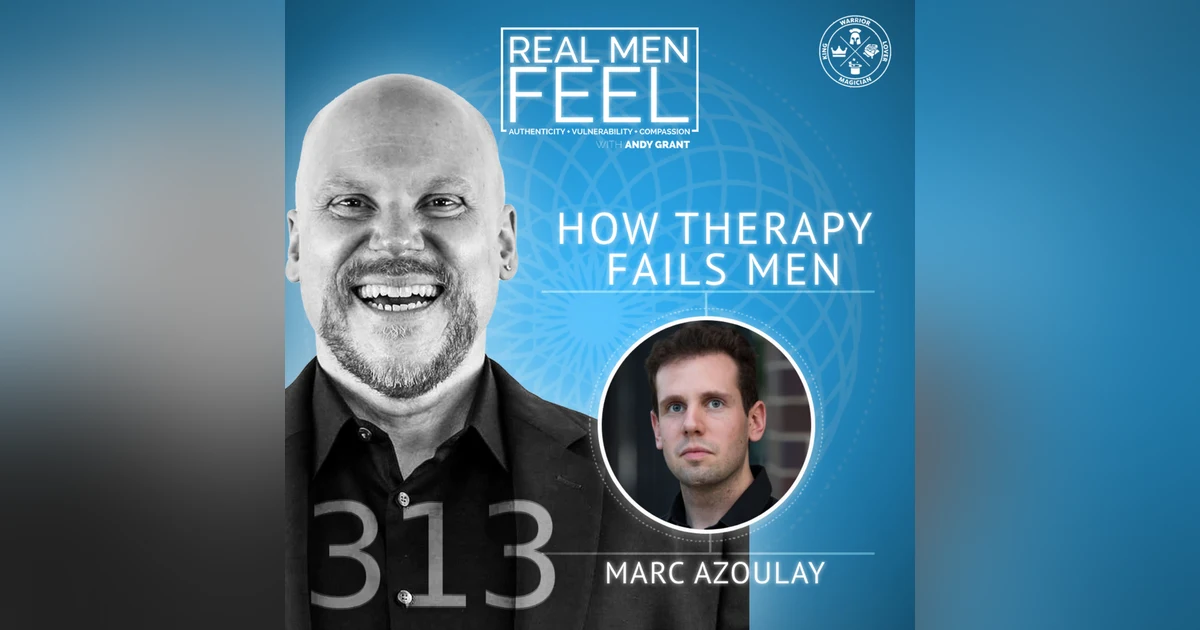

In this episode of Real Men Feel, host Andy Grant interviews psychotherapist Marc Azoulay about the unique challenges and shortcomings of traditional therapy for men. Marc shares his personal journey from client to therapist, highlighting how his own struggles with addiction and identity shaped his approach to helping men.
The discussion delves into the importance of challenging men within a supportive community, the need for both masculine and feminine love in therapy, and the transformative power of male initiation rituals. Marc also introduces Men's Therapy Online, a community-based service designed to offer tailored support and foster meaningful relationships among men.
Topics and Questions
00:20 Meet Marc Azoulay: Psychotherapist and Founder of Men's Online Therapy
01:15 Marc's Personal Journey: From Client to Therapist
03:07 The Challenges Men Face in Therapy
06:09 Redefining Masculinity and Therapy
07:35 Marc's Addiction and Transformation
13:41 The Importance of Male Support Systems
16:06 Marc's Therapy Approach and Personal Experiences
18:07 Vision Quests and Fasting: A Deep Dive
18:53 The Importance of Initiation Rituals
20:03 The Power of Fasting and Survival
22:01 The Mankind Project Experience
24:50 Leading Wilderness Retreats
28:43 Men's Therapy Online: A Community for Men
31:32 Emotional Strength and Vulnerability
34:18 Conclusion and Resources
Links
Marc Azoulay -- http://www.menstherapy.online/
Connect with Andy and the Real Men Feel Podcast:
Interested in a Clarity Call with Andy? - visit theandygrant.com/talk
Instagram | @realmenfeelshow & @theandygrant
Personal Website | theandygrant.com for coaching, healing, and book info!
Podcast Website | realmenfeel.org for all things podcast-related!
RMF Facebook Group | realmenfeel.org/group
Support this podcast | https://anchor.fm/realmenfeel/support
YouTube | https://youtube.com/realmenfeel
#RealMenFeel ep 313
0:00 Hello and welcome to Real Men Feel. I'm your host, author, coach and healer, Andy Grant. Please visit theandygrant.com to learn more about me. Real Men Feel exists to remind men that they are human beings and have the right to experience and express all of their emotions. We have conversations that most men are not having, but that all men can benefit from. My guest today is Marc Ajolet. Art is a psychotherapist and the founder of Men's Therapy Online, a community and healing hub for men who want to get back on their feet or take their lives to the next level. With a background and psychoanalysis, neuroscience and Buddhism, Mark is able to help men uncover and destroy the unconscious barriers that hold them back. His mission is to help men become the best versions of themselves and truly show up for their lives, relationships and community.
0:49 Now, as a therapist, I found it very brave that Mark wanted to come on the show to talk about how he sees therapy often failing men. He also gives lots of insight about initiations and rituals and working in nature and the need for men to challenge themselves in a supportive community. Let's get to it. Hello and welcome to Real Men Feel Mark. Happy to be on the show. Awesome, good to talk to you. What got you interested in being a therapist? Oh yeah. So Long story short, essentially I was a client. You know, I think a lot of therapists benefit from therapy and then end up going into the work themselves. Kind of go through my whole life story. As a kid, I didn't really fit in with guys. I was an overweight Jewish kid in rural Maryland. So I just got bullied into the ground and didn't really like myself.
1:39 School wasn't really a safe place. My home wasn't really a safe place for a number of reasons. So I just kind of like withdrew, stayed in my room a lot, played video games, just like really was isolated and shut down. People said I was both shy and wise for my years because I think they said I was a good listener, but really I was just like, didn't know what to say, you know? So I end up going to college, right? I hated who I was. So I decided to create a new persona, which is what any kind of like 17 year old boy thinks is cool, which is like drugs, rock'n'roll, you know, fast cars, women, all that. But I wasn't that kid. I was just like a nerd. I'm like a dork, right? I'm a Dungeon Dragons person. So like, I was in this place where I was just saying yes to everything, and that meant risky behaviors, that meant drugs and alcohol, that meant everything that I could, which eventually culminated an addiction.
2:24 Then I got to there and I don't remember really why first therapist setter did, but I do remember that he gave a shit and he was really interested in me. I had never experienced that up to this point. And he was like an emotional male mentor in a way he didn't quite have. My dad is phenomenal. He's a really good man, but he's not emotionally accessible. He's like very logistics focused. He shows his love through acts of service. And I need someone I can really just like talk to. So yeah, went through addiction, started my practice about 10 years ago working with dictionary recovery, worked in the jail for a while and then now I do men's work. So there's a lot to that story. If I wanted to be kind of the Cliff notes, because I could be the whole episode if I. Cool.
3:07 So one thing that struck me when we first spoke was that as a working therapist, and as some of you said, your first therapist was very good. You got success. You felt heard and supported. But you said, do you often talk about how therapy let's men down? So how does a therapist believe that therapy is letting men down? There we go. There's the topic right there. Yeah. And I'd be curious. Yeah. You're experienced either as a client or a practitioner. But like, I think therapy in general is it start as a male profession, right, as most things do. But now as a female dominant profession, I think it's changed over time. So what we talk about a lot in the therapy world, this idea of safety. And a client needs to feel safe. And if they feel safe, then they'll open up. Well, The thing is, a lot of men actually feel safe. You know, we're the most privileged group in America. We have safety out the ass, but we don't have is respect. And respect is something that has earned right, whereas safety is something that give it.
4:05 And I think a lot of therapists fail because they're not, you know, engaged in respectful behaviors. And what that looks like for a man very specifically is a lot of therapists, often women therapists validate all the time, right? We're taught in therapy school to do that, to just like validate all the feelings, say everything is OK, let it go, right? Just be like, Oh my God, it's so hard. Your life is so difficult. And as men, we don't want to hear that because it makes us feel like victims and it makes us feel like there's no way out. It makes us feel like we're being smashed by the world. It makes us feel like we don't have any power. And a lot of guys also lie and or obscure the truth, you know, So I think a lot of men want to be called on their bullshit. When I ask my, the guys that come to my practice, what would make me a good therapist, they say, Hey, call me all my bullshit, you know, tell me when you think I'm fucking around. Tell me when I'm doing the wrong thing. I think masculine love and therapy is ultimately selling love.
4:57 Their masculine love is a much harsher thing, but it comes from wanting the person to be the best version of themselves, if not bullying, right? But it is saying like, Hey, I know you can do better. I know you can do better than what you're doing and I'm going to help you there. So I think a lot of like basic kind of what I would call validation therapy. Men don't get a lot of value out of it because we need more action. We need someone that we feel like it's a teammate, a coach. We don't often need like a wet nurse, which I think therapy can turn into sometimes. Yeah, no, I agree. So I've had men therapies, therapists and counselors and psychiatrists and psychologists as early as I think 12 years old. And it's funny looking back, I'm like, Oh yeah, like the men are some of the first men that were honest and supportive and wow, I got a lot of growth and help from that. But then it was women.
5:47 That was often. Yeah, just this valley thing. And I feel like, oh, this is just bullshit and nonsense and but it. But it didn't, you know, I didn't. In hindsight, I can see all that and bet the back then especially, I often didn't want help. I would get help because family and friends were concerned enough but I was like yo fuck you you're not getting through to me kind of attitude a lot. But did did you say therapy is selling love? Yeah, so I like, I, I think therapy what we're selling the products you're buying is love, right? You're buying unconditional love, you're buying support. And I do think matching a feminine love are different and I think people need both, right? And one's not better than another, but I think it's ultimately love.
6:27 And all my clients, I love them in a way, you know, I, I turn people away who I can't love, who I'm like, wow, I really can't find a way to love you. You know, I don't think that would be very helpful to that. It's good that you can be honest enough with yourself and potential clients and not just, you know, chasing, oh, I need a new client. Better say yes to everybody. That's a that's something I see for a lot of coaches. And you know, one thing, one thing that I benefited from coaching and why I went into coaching is that unlike my experience with therapists, therapists didn't would just listen and nod and validate and they wouldn't tell me to do something like, yeah. And again, you said call me on my bullshit. Tell me I'm full of crap. Like you're just taking everything I give you. And I'm going.
7:09 I drive home laughing. Yeah, didn't was a great. Well, and yet you're back to that point. You lost respect for them, right? Like maybe in the moment it feels good to like con your therapist, right? Or be like, oh, I really got away with that one this time we're like, whoa, dodge the bullet. But after a while, it's like, wait, why didn't they pick up on that? Like, why aren't they pushing me? The respect goes down and then the effectiveness of the relationship just bottoms out, you know? Right. Yep. Right. So your experience with addiction was that, did that start in high school or in college or even later? This started in college. Essentially, it was kind of like reinventing my persona. And because I was a very fragile dude, like I said yes to everything and I pretended like I already had experience.
7:52 So, you know, if there was cocaine at a party, I was like, Oh yeah, I've done coke tons of times. Rack them up. You know, I got that kind of like masculine hit, toxic masculine hit of like being the guy who was the most fucked up and could hold his shit together, You know, like it was just like, and it became a snowball very quickly. So if you perceived being a man meant saying yes to things like, how did you learn that's what it means to be a man? I think it was more so like not being a coward. A lot of men and maybe you felt this. I know I felt this growing up. A lot of young boys, I guess should say we have like an anti personality. We don't know what it means to be a man, but we know what it means not to be a right.
8:35 And that's like being a coward. That's like, you know, let's see your T-shirt, the name of the show. Like having feelings, right, Being emotional. You know, I'm being a pussy, right? Like being stupid, being slow, being fat, right? Like all these things. We know what it means not to be a man. We don't quite know what it means to be a man. I think our culture and that's the whole other thing, families I think don't do a great job educating a positive, you know, sense of identity. That's a lot of it's still negative. So yeah, I, I didn't know. I didn't think being saying yes meant I was a man. But being I didn't want to be a coward, you know, So when everything there was anything risky where there was something that like I could maybe be judged for being a coward or for being afraid, I would just plow through that and say yes, right? Like just sign me up and do it again to my detriment. There were like fears.
9:21 Good. It's telling me that like something's a little bit out of my league. But I tried not to listen to that at all. Yeah, yeah, I find in my life growing up and it's so many men I meet, The most common mask we as men wear is the got it all figured out. Yep. I've experienced everything that you might suggest to me and let's just plow ahead. Yeah, yeah. And that's what man's planning is, right? I mean, that's why women, you know, again, it's bullshit because like, as man's planning, it's like we pretend like we're experts in something that we're not, right? I think people like talking to experts if we really know what we're talking about. But yeah, I think a lot of men come from that insecure place of like, the worst thing a man can say is saying I don't know or I don't have the answer. To this, yeah. And often that's I I often say that the bravest thing a man can say is is to ask for help.
10:08 But saying I don't know it's takes as much courage. Too. Absolutely. Yeah. I'm just, you know, I'm a man of science, right? And that's the whole principle of science is like being OK not knowing. Things. Yeah, right. Yeah. The only way we can learn, the only way we can grow or expand, is by admitting we don't know something. Yeah, absolutely. Cool, So what do you think it means to be a man today? Yeah, so I mean, let me take a break because there's a lot there. So I, I, I think the demands on men have really changed, especially in like Western culture is we don't have to be the strong man really any, you know, like there's very few physical threads.
10:48 There's not a ton of like, I don't know, wars that we're going to, right. I think we're very privileged, we're very insulated. And because of feminism, which is a phenomenal movement, I think women are asking for emotionality from their men, right? The standards on the emotional, even spiritual way is way higher than it's ever been. I think before, you could be like strong and rich and tough and come from like a good family and that's all. But I think now men are being called to do a lot more, and they're being called into roles that we typically or historically have not. Things like caregiving roles, things like the healing professions, teaching roles, places where we're actually are interacting with our community in a more nurturing way. And back to that kind of idea of masculine love.
11:28 We're being called to express our love more than we've ever had in the past because the rule is a lot, a lot less dangerous. You know, I mean, I know it can feel like it's kind of fucked up, but it's a lot less dangerous than it ever has been, especially on kind of the village level or small level, right? Like back in history, being a bandit was like a real professional pursuit that you could do. So, and I'll pause after I kind of do this. You can dive into more detail, but the kind of the attributes that I see as in modern masculine is strength, courage, mastery, and honor. And I'm happy to go into those in more detail. But I am curious your thoughts on that first point of do you feel like men are being called to do more today than ever? Yeah, certainly. But it's like everybody is as kind of boundaries between roles and are more more fluid and women can be anything and men can be anything.
12:18 And with the dissolvement of the traditional family, often men and women do have to be everything if they're the one parent in a family or, you know, raising children or watching a company and raising children, right? It's. Yeah. It's just not as a division of Labor that used to be between parents or traditional male and female roles really doesn't exist anymore. I agree and and it's not taken for granted right? Like I think roles in our relationship are really helpful. They don't have to be based on gender, right? I think it should be discussed and be consensual. But yeah, they don't. They're not locked into genders in same way they were historical. Because I remember when I was a kid, like a stay at home dad was just like, yeah, they weren't with God. There was an old movie like Michael Keaton, Mr. Mom, Like it was a comedy that a man was at home taking care of a family or raising people or doing housework. Like that was like hilarious.
13:10 And now I don't see that joke as much anymore, probably at all. It's just, yeah, it's much more common, much more accepted. But but yeah, there's still, I still see men having as many masks and just almost pretending to have mastery, not admitting when they don't know something or can learn something, pretending to have honor even at times. How does a man wrecking recognizing it takes strength and courage, mastery and honor. How does a man gain more of any of those? Yeah. Be uncomfortable, right? It's like, be uncomfortable. And I think that's also something we talk about how therapy doesn't help men in some ways, is that men growth through challenge and women go through growth through relationship.
13:55 You know, and again, I'm using just, I've always have to make this kind of like sidebar men and women loosely. Gender is fluid, right? There could be masculine women and feminine men, but I I think like masculine, you know, he's had a normative just for the conversation. I think masculine men grow through challenge and we grow through putting ourselves in shitty positions or things that push our limit, right? The whole get out of your comfort zone. And we need other people, mostly other men, ideally that we can come back to as a safe base. You know, a really common example that most guys have experienced is when dating, you're trying to talk to someone at a bar, right? Having a buddy there is so much easier, right? Because you can go out, you can talk to the girl, you can fail, you can have a funny story, but at least you have your buddy that you can shoot this shit with. You're there alone.
14:40 One, you're probably not going to be approaching strangers. And two, if once you get the first rejection, you're out of there, right? You're not going to have that anchor and that support. And I think that's something that guys can do for each other and really try to be those anchors because we, we are the rocks, you know, I think we need to be rocks for each other as well. Yeah, no, that, that's a great idea. That, and the notion that you need men that you're close enough and comfortable enough with that they can push you, but they can also welcome you back home after a push didn't go so well, perhaps. Yeah, there's a really great study in the Book of Boys and Men, which kind of talks about they were studying male and female parents at a playground, right? That's like a hidden camera, essentially. And they found that the female parent with little kid right, is like underneath the kid trying to catch the kid. If the kid falls right, the kids up in the jungle gym, the mom is right there trying to catch them If if they fall right? And the dad is up on the jungle gym with the kid, encouraging the kids to climb higher.
15:35 I think that perfectly really encapsulates the importance of both roles, right? You need someone that can catch you. We also need someone that can encourage you to climb higher, and I think that's what men are often lacking. It's like that encouragement to climb higher and to push beyond their comfort zone. Yeah, yeah, a couple years ago he had the author of that book on. And of course now I'm blanking on her name, but I'll, I'll link to that in the show notes. But yeah, that that she has some great insight and really seeing how early those roles start getting made. And almost the earlier they're made, the harder they are to to challenge her to break too. So how has your personal experience with your therapy journey, with your addiction journey, how has that helped you? Or maybe I shouldn't say that. How has it impacted the way you work with clients? Oh yeah.
16:18 I'd say it's definitely helped, you know, and I imagine you're similar when you do like the energy work and the coaching and stuff, and like the same with altered states that I'm sure you've experienced and emotional states that I'm sure you've experienced. If we can go there ourselves, we can be there for another client, right? We can be there for our person. So I ask every single person who's interested in therapy, it's like always ask your therapist, are they in therapy? Have they done it? What's their journey? If they say no, get out of that office because they need to be able to hold not just how intense you get, but one or two steps beyond. So again, you can be encouraged to go further and feel deeper into your feelings. So I think for me, you know, through addiction and, and through my own, you know, I've done tons of men's initiation ritual, tons of men's work, a lot of psychodrama, all these kind of buzzwords.
17:02 But like, I've been on the floor screaming and crying. I've punched things. I've spent, you know, weeks fasting in the wilderness. I've been through like the depths of addiction and seen people die. I've lost friends, I've committed crimes. I've so I sold drugs for three years. Like I know some shit. And I think that's really important to find a therapist. Again, it comes from that respect place of respecting somebody who's lived experience includes some of these more extreme states because then when you go there or when you have to go there, that person can hold you and they don't push you away. I think a lot of people experience that with grief is when they lose somebody, especially if it's someone that, you know, quote, isn't supposed to die like their kid or their wife. A lot of people push away because they don't know how to deal with that loss.
17:48 They don't know how to deal with the grief. They often don't return phone calls, they don't return text messages, but they're not checking in on you. And a lot of people take that personally. But really, it's the other people that aren't able to deal with the the heaviness of what you're doing. Yeah. So I felt a lot of heavy shit so I can hold it too. Yeah, no, I I get that and totally agree. Of all the different rituals and passages and things out in nature, and is there anyone experience that you'd recommend the most? Yeah, there's a bunch. I mentioned the fasting, so I think I'll talk about the fasting. That's really interesting. So I worked with the organization called the School of Lost Borders. You can Google em or you can throw in the show show notes or whatever, but they do vision quest and vision fast.
18:28 And the idea of it is that you spend about two weeks out there on the land and then you don't need for five days and they put you in a location in nature and you're just camping with not even a tent. What? You have two tarps. You have one tarp that goes underneath you and one tarp that you hang from some trees, depending on how hardcore you want to be or what type of year you go. You don't have a sleeping bag. You don't have you basically have nothing. The only thing you have is water, able to drink water. You get one gallon per day. I brought like a notebook, but aside from that, I had basically nothing. So no flashlight, no bug spray, one change of clothes, you know, like as bare bones as possible. And for men, I think we need this, right? So the idea is that this is like an initiation or a tool. And I'm sure you've talked about it for on your show. So I'll just say briefly, many cultures have these kind of coming of age initiation rituals where a boy becomes a man. And really what it is if you strip away all the spirituality, all the woo woo, because I know a lot of guys don't believe in that.
19:25 What it is, is proving to yourself that you're not a pussy really, right? Doing something really hard that you don't think you can do and then succeeding and being like, holy shit, that was that. I'm stronger than I thought I was, you know, and for initiation ritual, it's going to be different for all guys because our proclivities are different. But it should be scary. It should be really scary. If you're not afraid of it, it's not hard enough. And if you're too afraid of it, then you probably shouldn't do it, but should be like some level of fear where you're like, oh, this is going to be tough. This is going to be really hard and you should struggle during it. Again, if it's a cakewalk, then it wasn't hard enough. And if you fail and it was too hard, then you got to try again. But I think this idea of.
20:05 Going out there and just surviving in the most primitive way possible, having a lot of time to be with yourself. And this idea of fasting, which I'm not sure if you've done any long term fast, but you get real weak you you have. Are you saying yes? Yeah, five days is the Max. I think I've done 5 days once and I've done three days a number of times. Yeah, it's wild, right? So like, usually for me, like around day two, I get real weak. Like weaker than I've ever felt. My bones feel heavy, my brain starts to shut down. I feel like I'm just like slogging. But if I can pass through that, there's this like immense clarity that comes up because I think when the body is is starving and it's like looking at death, all the bullshit just burns away.
20:49 And all the thoughts that that I have and I'm sure that you've had are like very clear. They're very precise. You almost can't ignore them because they're just so strong. You know, it could be a spiritual experience. It could be almost like talking to God or an Angel or some kind of divine thing that just like spitting truth at you all the time, you know, and you couple that with a, with a survival element and, you know, I came back there being like, man, this is something that I did that I survived, that I learned a lot from that's going to really impact me. And it creates this kind of milestone in my brain that I can call back on if I feel weak or if I feel afraid, which is OK, right? Like men can feel that, but it gives me something like, OK, if I went through that, I can go through this. So I think doing some kind of initiation ritual. I like the primitive stuff.
21:33 So those spirit quest and the fasting was like really cool for me. For other guys, it can be things like, you know, a sports thing where like a giant bike ride or a marathon. They can be a relational thing, like trying to talk to a new person or kind of getting their comfort zone that way. A lot of people that are religious do things like midnight vigils or they stay up all night in prayer. So it doesn't have to, doesn't have to be anything specific, but I think men have to do that every once in awhile just to be like, yeah, I still got it, you know? Yeah, yeah, I agree. So it was the one thing I've done in steel staff. But I do the initiation weekend with the Mankind Project. Yeah, the Warrior Weekend. It's great. Yeah, I'm done. Yeah, great. Yeah. So I did, you know, we, I interviewed the head of marketing on this show years ago and they talked about it and it happened to be that it was coming up in a few weeks, literally 1/2 hour from my house. So like I said during the show, OK, I'll do that. And yeah, it was, I went in cocky because I'd been through all sort of things already and I volunteered first the stuff and I was immediately like bawling in a mess and like, Oh my God, having breakthroughs.
22:32 And so it was great. And now I've, I'm actually staffing again. Let's see in October, it's in Massachusetts again. So I'm, I've, this will be my third time staffing because. But at that, that's something I recommend to everyone because it's challenging enough, but it's not such a physical thing that if anyone, any man, any age can do it, but it's still a challenge. Is that was that your experience? Yeah, absolutely. And, and I think it is masculine love because I won't spoil it because I think part of it being a surprise is critical. But they will push you, right? And they will throw things in your face. And it's like very confrontive. But once someone does break and like you said, they're bawling on the ground, it's so much respect like that. There's no weakness in that, right? Like you're embraced by the community of men. People like, help pick you up.
23:14 They want you to get better. They want you to be stronger. They want you to do confront stuff that maybe you've been avoiding your whole life. I think that's nice. Going to love again. It can look like bullying sometimes, but it has that like aftercare and that embrace afterwards that's so critical of being like, yeah, you, you had this breakthrough and we're going to help you deal with it. We're just going to leave you. There's plenty of Facebook reminded me just last week. It's been 15 years since I first did something that was this challenge. And yeah, I don't want to the the guy I did. He was the first person, my first like mentor coach and had the challenges and had the fasting and the real physical challenges and the mental challenges.
23:56 But unfortunately people died under his watch so. It took a long. Time for me to trust and dare follow anyone else to some sort of live event. But you know, I'm glad I did. But yeah, just so you said earlier, be careful if you're really scared, it probably isn't something for you. You just. But it should you want to be. You want to be frightened, not terrified. Exactly. And a lot of places like the organization, I recommend School Lost Borders, like they have people that know of Wilderness first Aid that work there. There's assistance like when you go out and you find your spot, they plot you on GPS, you know, so if you don't come back or they don't hear from you, they can come get you. So like there is some modern safety Neps there. But again, if you don't interact with them, you are totally alone.
24:37 But yeah, I would recommend to listeners definitely do your research and make sure they have some safety in place just in case. You never know. And so you've done a lot of these sort of primitive ritual things. Do do you actually lead any of those sort of things these days? I do facilitate, so I do 3 wilderness retreats with my company, Men's Therapy Online. This is not online part of it. We do 2 wilderness retreats and we do one kind of psychodrama retreat, which is probably similar to the Warrior weekend where we're acting out issues that guys have internally in a community of men. And they are both, you know, we employ a lot of nature rituals. For instance, the one that's coming up in September, I'll just go through real quickly is but Colorado has a lot of mountains. I'm based in Colorado and we're climbing a 13 here, which is a 13113 thousand foot mountain.
25:20 So it's hard. It's it's a hard climb. You know, there's a lot of fourteeners in Colorado and they're famous. We don't do them because they're crowded. So there's a way more thirteeners that you can have some privacy, right. So the idea of this retreat is called the Burdens We Carry. So we'll have the guys, they'll come to the base of the mountain, we'll establish a base camp, we'll do men's group, we'll talk, we'll connect. And then I have them build something from natural materials that represents a burden in their life when it should be uncomfortable. So usually it's something that's like really heavy. Maybe it's a big rock, maybe it's like a spiky stick, maybe someone's wrapped in thorn, something that's like sucks, right? It's a burden and they have to carry it up the mountain, right? That disturbs themselves. So the more uncomfortable, the better.
26:00 And they're had this experience doing what is already a difficult hike, but now they have this thing that they're carrying that is maybe hurting them in some way, right? Nothing too dangerous, but it's chafing them. It's heavy. It's it sucks. We get to the top and we do a ritual where we basically do again, a men's circle. We talk about it and one at a time, the guys throw the thing off the mountain, right? They throw it all the way down. And that's, you know, why making natural materials can just go back to the earth. But we throw it off. And there's this like wonderful experience where some guys that do that, the minute they toss that thing, they are just crying, right? They're just like getting this experience of shedding this thing that has been like such a thorn in their side. And then they walk down and going down is easier than coming up. So, you know, it feels better.
26:45 You're not carrying the big spiky rock and you come back down. And what's critical about our retreats that I wish Moore did is that we do a lot of integration. So we have a circle. Then we do a touchdown meeting the week before or, sorry, the week after. And then we do a check in two weeks later. Because, you know, say that burden was a shitty job, right? Just because you throw the thing off the mountain doesn't mean your job changed, right? You didn't quit your job. You didn't make any changes. You just like did a cool weekend and I found a lot of guys don't turn it into action. So we do this kind of long tail afterwards because even though you have that major cathartic experience, then you kind of again have that masculine love, the accountability of like, OK, man, like you just talked for three days about how much you hate your job hiked up this mountain. You threw the stone off the top.
27:33 Like when you going to quit, you know, get down to brass tacks, When are you going to actually make that change? And I think a community of men can really make these retreats meaningful instead of just being navel gazing. Because I think it's the combination of insight and action that creates change. And back to the original topic, a lot of therapy is just insight. There's no action, right? So you guys get stuck? Yeah, cool. It reminds me of the notion of carrying this burden and having a a metaphor physical thing. I was, I think, 19 years old and I had made another attempt on my life and I was in a mental hospital and a psychiatrist could tell I I wasn't sharing. I wasn't opening up at all. He made me drag a suitcase around for the whole day and I'm like, fine, I'll do that. Like I know what you're the point is, but everyone can ask me why do you go to suitcase?
28:18 Hey, man. So I was like, I was getting attention. I was like, oh, my, my baggage is making me famous today. Like the so he saw that I was like, and he's like, Yep, he's all right. Next time I do this for someone, we're going to put a full of, fill it full of rocks and make it. Much more uncomfortable. It was easy and it and I was getting something from it. So yeah, lesson not learned my friend, right? Exactly. Yeah. Not challenging enough, right? close, but not challenging enough. Yeah, Yeah. So tell me about men's therapy online then. What is the non woodsy portion? Yeah, so. We are or therapist by men for men, right? So all of our practitioners are male. We're all licensed clinicians. I only hire industry veterans. I don't hire new graduates. A lot of group practices do that, but we're designed to be kind of a boutique community based service.
29:01 So for those that are therapied, I know the lingo, we're somewhere between a private practice and an intensive outpatient program, which is an IOP, an IOP program. You kind of do therapy three days a week. You have all these like cool activities, but you have to do all of it right at at MTO, it's all a la carte. So people can turn up and turn down whatever kind of interaction they want. So we offer group basically everyday. We have multiple groups. Some people aren't once and for a few of them we have individual that meets every other week or weekly. We have those retreats and then we have some fun stuff like we do free community events where people meet up when we go on a hike in Colorado, you know, a book club. We have some online courses. We have one on perfectionism that I just launched. So we have a bunch of like kind of perks that people can dial up and dial down.
29:43 But the idea is really it's a right, like therapy is the vehicle. And I think a lot of guys, especially post COVID, are now valuing therapy and coaching work and self development work or whatever you want to call it. But really I'm trying to get guys to talk to each other because I do think we are still very isolated. And a lot of male friends are, which again, I have tons of these and they're great. Like hobby friends, right? Like gym buddies or friends that you play basketball with or whatever. But this is designed to be your emotional gym. Whereas these are the guys who I talk about my feelings with. And over time, it becomes a chosen family. It really becomes like a band of brothers. And what's different from my practice in some ways is that I encourage my people to be friends. So there's a Slack channel that everyone can talk to and they can all message each other through all the time. All right.
30:29 I've had people hang out without me there and go on hikes. I've had two guys that became best friends and they were at each other's wedding. Like, my goal for that thing is that they're at each other's funeral, right? That these have become lifelong connections that, yeah, maybe start at at MTO, but ultimately become real meaningful or let's just. That's because I think that's what the world needs. We just keep talking to each other and we need to be supportive and, and love each other. I There's so much isolation, right? Now and that you host a podcast too, right? I do, yeah. That's called the Men's Therapy Podcast. Yeah, pretty much fine. It's very similar to this show. And I'll, I'll have you on to the guest for sure. But it it's very similar, right. We just talked about men's mental health and, you know, most podcast listeners are male.
31:12 So we again, kind of getting off that ivory tower that a lot of therapists are on. It's like we're going to go where the people are. We're not going to expect you always to come to us. So of all the different experiences you've had and insights and actions, does anything stand out as something you wish more men knew? I think, well, I'm looking at sure, real men feel so I think that's one thing, right, Is that like strength is not just physical strength is emotional. And back to the point I made earlier, I, I think a lot of men, and I'm going to say specifically fathers in some way, like push away emotionality from their children. I think that creates a huge problem. So I think like, it is strong to be able to lean in when your kid is upset versus shutting it down. It's strong to talk to your daughter about her getting bullied in school instead of trying to tell her to suck it up.
32:03 It's strong to talk to your son about how he's afraid of going on this field trip instead of like just pushing him past his capacity. You know, like, emotions are strength. And I think once you're on the other side, which I'm sure you are and yeah, I know you are like that toxic man, that bully, you see how weak he actually is. Well, now it's something that I was truly afraid of most of my life was the bully and and the kind of like macho jerk. But once I'm on this side, it's like, oh, they're just like empty, you know, there's a feeling of sadness, there's a feeling of lack there versus being like real strength is like masculine using its emotions to inspire, protect and care for others. So, yeah, don't be afraid of them. That could be the biggest source of strength. And it's just life at the end that like that's how you feel alive is by feeling things.
32:50 I think so many dudes, Ross, are so dead because we're just pushing everything away and our aperture is so tiny that like, we don't get touched by the world, we don't feel anything. And that that sucks. That's just like being a robot. Yeah, yeah, yeah. I, I, I hear from so many guys and I'm glad to hear more and more guys are kind of waking up and acknowledging they feel empty and lifeless, but they control so much of that. And by, yeah, being allowed to, you know, deciding I'm going to feel more than hungry and angry. And then then I'll feel more life. Yeah. And actually be alive. And, and see what how cool Earth is, you know, because there's a lot of stuff out there, like there's a lot of stuff going on in our planet that you can check out.
33:31 But I think a lot of guys again, live in their comfort zone, whether it's that back to that macho jerk thing where I think they're just like very controlled. They only do things that they're confident in. So I didn't see more in my generation than a pat that I easily could have walked down, which is kind of like depressed, isolated video games. Just like living online, you know, I think we're missing life in so many ways and something. Can be your comfort zone and it doesn't feel very comfortable. Like it can be horrible, but it's your comfort zone. Yeah, absolutely. Yeah, like, I mean. I, it's like you, I also struggle with depression and it's like horrible and I hate it. And it's very comfortable, you know, like I can be in that state. And it's usually because I'm, it's not because I'm sad, it's because I'm afraid and overwhelmed and I don't have the resources to push myself out of it. But I I empathize like it feels really bad and yet I can like settle there.
34:21 So, so, Mark, what's the best way for people to learn more about all the things that you're up to? Yeah, Best thing to do just. Check out the website, it's menstherapy dot online and that's everything is there. So that's like the business page. You can sign up for our groups and retreats or whatever, but there's also a ton of free content. There's a book list if you just want to get started and you want to start reading asynchronously. There's the podcast. I have a YouTube channel. Like everything is there. So like I think for a lot of guys, especially young men, I don't know anybody. Like I had a lot of digital mentors and virtual mentors. When I didn't, when I couldn't find other good men in my life, I watched a lot of Youtubers, read a lot of books, read a lot of biographies. There's a lot of historical texts. I think like men need the wisdom of other men.
35:02 So whether or not you pay for pay me or not, right, like there's this, there's a lot of value in consuming the asynchronous content and finding your digital mentors. So we hope to connect you with some of that too. Awesome. Awesome. Well, Mark, it's. Again to the second time we've ever talked and I enjoyed both times immensely. So yeah, let's definitely, yeah, let's talk again. Keep this going and wherever you're catching Real Men feels, please visit realmanfield.org. See the blog post for this. We'll have links to all the books and resources mentioned and ways to connect with Mark. Wherever you're discovering Real Manfield, please subscribe, follow, like, share this with someone that would get as much value as you did or even more. Post a review, a comment. You can reach out to me at realmanfield@gmail.com. Always glad to hear from you and until next time, be good to yourself.